MedAI Hackathon 2026 Complete
Thank you to everyone who made MedAI Hackathon 2026 unforgettable. This page is a short look back at the weekend: what we did, who showed up and the real-world AI problems teams took on at the Center for Computing & Data Sciences.
Event recap
Looking back at April 10–11, 2026
More than 230 people from across Boston University registered for two days of onboarding, team formation, mentorship and building. Participants worked in mixed teams on challenges sourced from BU labs, with secure data access, GPU-backed compute and support from organizers and domain experts.
Moments from the hackathon
Collaboration, mentorship and celebration from MedAI Hackathon 2026.
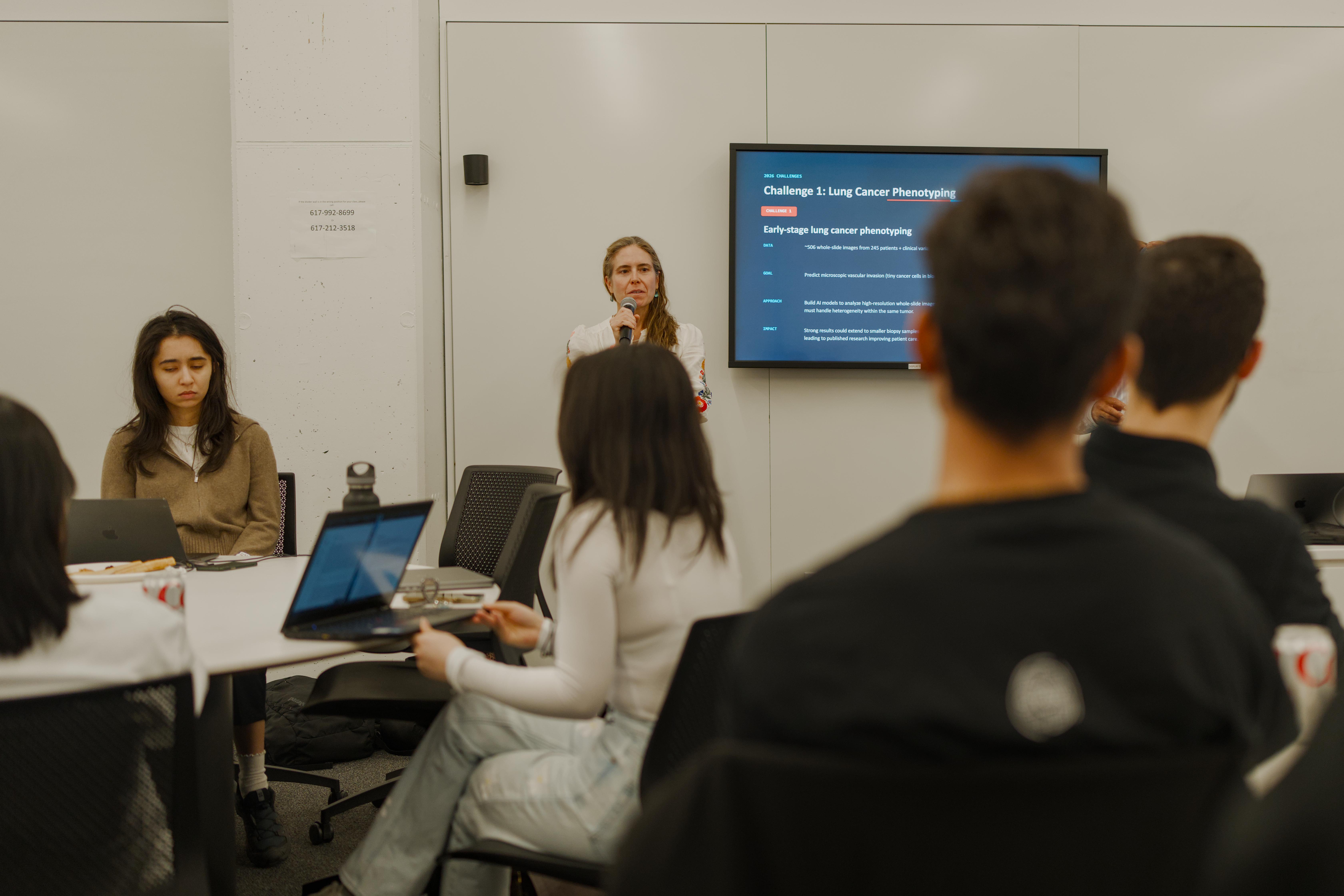
What teams worked on
Three faculty-led tracks drew on de-identified research data. Teams built models under hackathon constraints.
Early-stage lung cancer phenotyping
Using H&E whole-slide images from lung resections and biopsies, teams modeled subtle histology patterns linked to vascular invasion and aggressive growth.
Amyloid PET for Alzheimer’s disease
Participants worked with 3D amyloid PET scans and tracer labels to predict standardized Centiloid burden.
Acute tubular injury from proteomics
From pre-biopsy SomaScan protein profiles and clinical covariates in the Boston Kidney Biopsy Cohort, teams predicted acute tubular injury.
Challenges were sourced from BU research groups and aligned with the university's emphasis on interdisciplinary convergence in health and biomedicine.
What we saw together
The hackathon brought together over 230 registrants from across BU for a high-energy weekend centered on biomedical AI: cross-disciplinary teams, hands-on modeling, and conversations that bridged clinics, labs and computing.
The event reflected BU's commitment to convergent research by connecting medicine, data science, and computing in a way that was technically ambitious and community-driven.
Two-Day Event Summary
MedAI Hackathon 2026 ran across two vibrant days at Boston University. Day 1 focused on onboarding, team formation and challenge orientation, while Day 2 featured focused project development, judging and awards.
Day 1 - Kickoff & Collaboration
Onboarding, team formation, and challenge setupDay 2 - Build, Demo, and Awards
Project sprint, presentations, and recognition$10,000 in Prizes Awarded
Top teams were awarded cash prizes and recognized for their contributions to biomedical AI research.
* Prize amounts were awarded per challenge track and represent the total reward for each winning team (shared among members).
Supported By
Proudly backed by leading BU centers and departments advancing biomedical AI and health data science.